Appearance
IVW26: Interactive Visual Workflows for Science and Engineering at Scale
Organizers:
Francesca Samsel (TACC), Silvio Rizzi (ANL), Axel Huebl (LBNL), Jefferson Amstutz (NVIDIA), and Berk Geveci (Kitware)
Keywords: interactive visual workflows, high-performance computing (HPC), scientific visualization, AI-augmented analysis, simulation and experimentation, in situ and streaming workflows, data management and orchestration, usability and UX
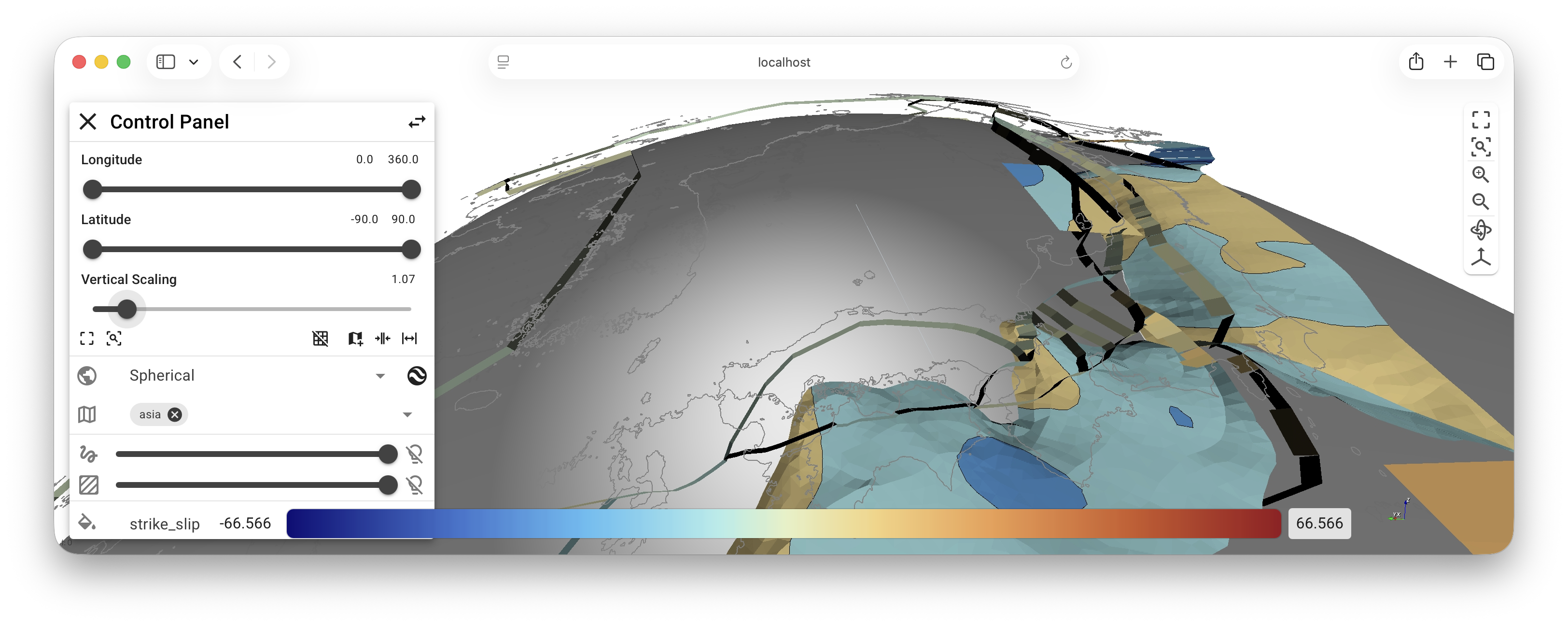
Parsli - Fault System Kinematics Viewer
Abstract
Researchers, practitioners, and tool builders come together in this workshop to reshape how we perform science and engineering by using interactive visual workflows as core instruments of discovery. Interactive visual workflows tightly couple computation, experimentation, AI, data, and rich visual interfaces, with visualization as the central feature at each step to support visual steering and inspection, deeper analysis, and more transparent communication. They directly tackle a growing bottleneck for SC attendees: teams spend so much time designing simulation and experiment campaigns, then analyzing and visualizing results, that this work increasingly dominates the path from project start to discovery and can even outlast available compute time. IVW highlights concrete approaches that shorten this design and analysis loop, often to days or the runtime of the computation itself, and showcases workflows that make complex pipelines understandable and actionable through focused papers, lightning contributions, and hands-on demonstrations.
Motivation
Modern simulation and experimental campaigns are no longer linear pipelines; they are iterative, AI-in-the-loop workflows.
In simulation-driven studies (e.g., CFD), practitioners still navigate geometry preparation, meshing, solver configuration, and post hoc analysis, but now also train and deploy surrogate models, use learned models to propose new parameter sets or candidate designs, and run targeted simulations to validate and refine those suggestions. Simulations become simulate → analyze → learn → propose → verify loops where ensemble management, provenance, and cross-run comparison are as central as any single run.
The same pattern is emerging in experimental science. Contemporary instrument workflows span calibration, acquisition planning, high-throughput data collection, reconstruction and preprocessing, and multi-modal analysis, but increasingly these stages are guided by AI models for online quality control, adaptive acquisition, feature detection, and active learning that decides what to measure next. Experiments become measure → assess → learn → adapt → confirm loops that couple instruments, compute back-ends, and visualization for rapid decision-making.
Across both domains, the challenge is no longer simply running a simulation or an experiment; it is orchestrating these interdependent loops that tightly couple computation, experimentation, AI, and visualization. General-purpose workflow systems can offer breadth, but often at the cost of steep learning curves and fragmented user experiences; bespoke, visually driven workflow environments, in contrast, embed domain knowledge directly, integrating data management, analysis, and interactive visualization into cohesive systems that support iteration, comparison, and discovery.
Scope
Interactive visual workflows bring together computation, experimentation, artificial intelligence (AI), data, and rich visual interfaces into end-to-end pipelines that people can inspect, guide, and trust. Visualization is the central feature that ties together many steps, from visually defining and configuring simulations or experiments, through training and deploying AI and surrogate models, and running simulations and experiments on high-performance computing (HPC) back-ends with in situ and streaming support for inspection, to post-processing analysis and comparison of results that guide follow-on simulations and experiments. Across all of these, the goal is to replace long, opaque, tool-fragmented cycles with workflows that enable scientists and engineers to interact with their data and models in a more immediate, intelligible, and collaborative way.
We are designing the workshop to move this emerging area of HPC- and AI-enabled science and engineering forward in a coordinated way. We are particularly interested in giving the community space to name and refine the core ideas of interactive visual workflows, from the shared vocabulary we use to describe them to the patterns and questions that recur across domains. At the same time, we intend IVW to be a friendly place for work that is still taking shape, where participants can bring new tools, early results, design sketches, novel and informative visuals, and lessons from practice and get constructive feedback. By gathering domain scientists, visualization and graphics researchers, data and AI specialists, research software engineers, and facility staff in the same room, we hope to spark collaborations that would not otherwise emerge within a single discipline workshop. The format also offers early-career contributors a chance to practice concise technical writing, reviewing, presenting, and demonstrating tools and workflows. We emphasize shareable workflows, code, data, and frameworks so that the community leaves with tangible artifacts that remain useful long after the workshop ends.
To support those goals, the workshop will not follow the familiar "keynote–papers–panel" formula. Instead, it will open with a short framing session led by the organizers to set the context, solicit core research questions on interactive visual workflows, and walk participants through the day's structure. We organize the rest of the morning into three clearly defined streams of contributions. In the first stream, contributors present selected four-page papers as focused talks that delve into concrete use cases, methods, and technologies, giving attendees a chance to see mature ideas and results. Between the first and third talk blocks, contributors of tools, platforms, and applications take part in a concise lightning round, with thirty seconds and a single slide each to convey the essence of their demonstration and help attendees decide which ones to visit in the poster-like session. In the third stream, contributors present two-page lightning papers in short, tightly timed slots, providing a structured venue for early ideas, exploratory designs, and strong opinions that benefit from quick feedback.
During the tool, platform, and application demonstration sessions, attendees move among demonstration stations, interact directly with developers and users, see workflows in action, and dig into implementation details that rarely fit into a talk slot. The afternoon mirrors the morning pattern, with additional focused talks from selected four-page papers and short slots for two-page lightning papers, providing space for both deeper technical content and early-stage work that benefits from fast feedback and cross-pollination.
We close the day with a facilitated group "talk show"–style discussion centered on the challenges and opportunities ahead: what is working, what is missing, and where the community wants to go next. This conversation draws explicitly on themes from the talks and demonstrations. It feeds directly into our post-workshop artifacts, including a concise "state of the field and call to action" document that captures shared priorities and concrete next steps. This sequence keeps the morning and afternoon paced and coherent rather than chaotic, while still exposing attendees to a diverse mix of work.
Relevance and Impact
What is the relevance? For SC attendees, a central bottleneck is the growing gap between data generation and actionable insight, as the time and effort spent designing simulation and experiment campaigns and then analyzing and visualizing results increasingly dominates the path from project start to discovery and, in many projects, takes longer than the period when teams actually have compute time on the supercomputer. An interactive visual workflow tightly couples computation, experimentation, AI, data, and rich visual interfaces, with visualization serving as the connective tissue among HPC, AI, data, and usability at each step of increasingly complex pipelines to support visual steering and inspection, deeper analysis, and more transparent communication. By focusing on interactive, domain-aware visual workflows that integrate AI, simulation, and experimental data, this workshop targets that bottleneck head-on and explores how to compress lengthy design and analysis into days or even into the runtime of the computation itself so that insight keeps pace with computation and instrumentation.
How will it impact attendees? The impact of this focus extends beyond performance metrics to who can meaningfully participate in HPC- and AI-driven science and engineering. Interactive visual workflows democratize capabilities often confined to computational specialists, making complex pipelines understandable and actionable for domain scientists, early-career researchers, and decision makers, while improving expertise transfer and supporting multi-audience analysis across desktops, Jupyter environments, HPC systems, and the web. We intend the workshop’s mix of focused papers, lightning contributions, and hands-on demonstrations to give attendees concrete workflows, tools, and design patterns they can adapt in their own environments, as well as early-stage ideas and emerging practices that point toward where the field is heading. DOI-backed artifacts, papers, slides, workflow descriptions, software, and images, together with a community-edited “state of the field, opportunities, and challenges” report, will provide durable reference points and a shared, forward-looking view of priorities for methods, infrastructure, and workforce development that attendees can carry back to their home institutions and future SC events.
Community Building, Inclusivity, and Goals
IVW deliberately weaves community building and inclusivity into its technical focus, rather than treating them as add-ons. We involve early career participants directly in the life of the workshop by inviting them onto an Early Career Program Committee and into the review process, giving them guided experience with peer review, program shaping, and session logistics alongside more senior members. The organizers and program committee span academia, industry, and government laboratories, and we will expand the committee with attention to diversity in institution type, geography, career stage, and background so that the workshop reflects the range of communities it aims to serve.
The short, rigorously reviewed paper formats, both four-page and two-page, lower barriers to entry and act as idea incubators, encouraging contributions from groups that may not yet have a full-length journal paper but have valuable tools, workflows, visuals, and emerging results to share. The call for participation explicitly welcomes domain scientists, visualization and graphics researchers, data and AI specialists, facility staff, and research software engineers, mirroring the interdisciplinary nature of interactive visual workflows. Demonstration sessions further strengthen this mix by creating informal spaces where developers and users can discuss real-world practices. Together, these choices support early socialization of work, build bridges between communities, offer a venue for HPC practitioners to discuss the state of the practice, and create concrete opportunities for professional growth in technical communication, leadership, and service.