Heat diffusion on a plate
Two hot spots on a cold square spread and fade as heat diffuses. This is a good first simulation: each timestep needs one stencil kernel, two arrays and a swap of Python references.
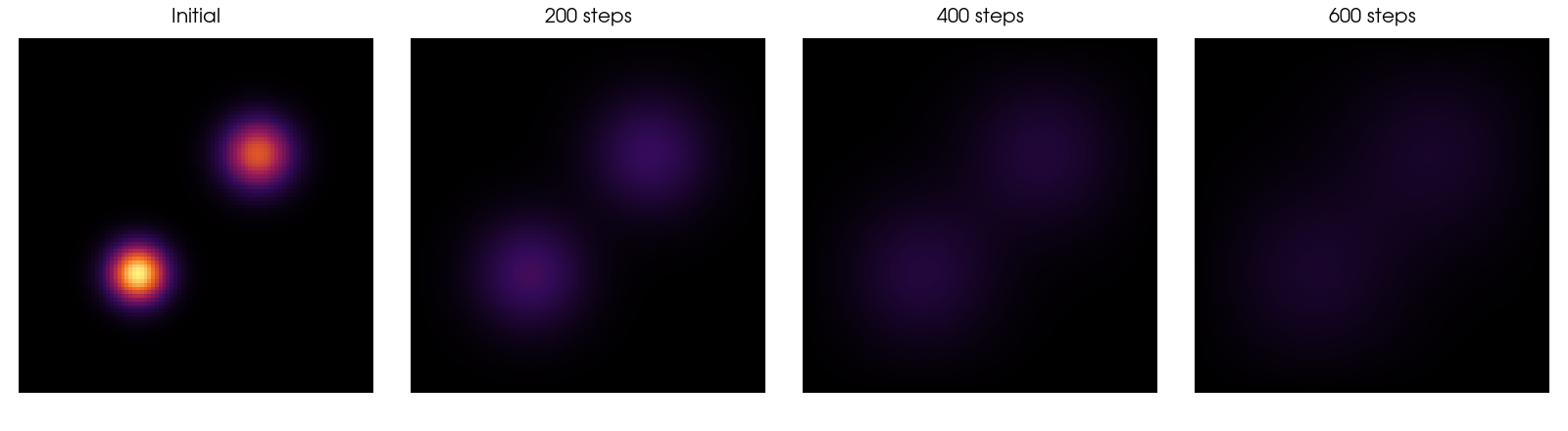
Origin: adapted from Tack's heat-equation example, Copyright © 2026 Kitware, Inc., BSD-3-Clause. This version swaps buffers instead of copying them each step and includes an independent NumPy check.
The equation and its storage
The heat equation is du/dt = alpha * laplacian(u). On a square grid with spacing
dx, an explicit step uses the four adjacent cells:
new[i,j] = old[i,j] + r * (old[i-1,j] + old[i+1,j]
                         + old[i,j-1] + old[i,j+1] - 4 * old[i,j])
r = alpha * dt / dx²
Choose r <= 1/4 for this two-dimensional scheme; the example uses 0.2.
The boundary is held at zero temperature. Heat can therefore leave the plate;
the total heat does not remain constant.
Each scalar array has shape (n, n). Here the first index is the plotted row
and the second is the column. Each iteration owns one output cell. It reads
neighbours from a separate old array:
@tack.kernel
def heat_step(old, new, r, n):
    for i, j in tack.ndindex(n, n):
        if 0 < i < n - 1 and 0 < j < n - 1:
            lap = old[i - 1, j] + old[i + 1, j] + old[i, j - 1] + old[i, j + 1]
            new[i, j] = old[i, j] + r * (lap - 4.0 * old[i, j])
        else:
            new[i, j] = 0.0
The boundary branch writes zero on every step. It also prevents invalid neighbour loads at the edge. Those loads are inside the conditional, so edge iterations do not evaluate them.
Repeat the timestep in Python
Allocate the arrays once and swap their roles after each completed launch:
    for step in range(steps):
        heat_step(old, new, r, n)
        old, new = new, old                 # swap Python references, not field contents
        if (step + 1) % (steps // 3) == 0:
            snapshots.append(old.numpy().copy())
The swap copies no array data. The next launch reads the just-computed state.
Updating old in place would give other iterations a changing stencil input,
so it would not implement this scheme. Readbacks are only for the figure's
checkpoints; remove them when timing the timestep loop.
Run and check
uv run python docs/examples/heat.py --arch cpu --check
uv run --with vtk python docs/examples/heat.py --arch metal --output heat.png
The first command compares forty small-grid timesteps against a NumPy slice
implementation and checks the zero boundary and the temperature bound. For the
figure, run without --check: it shows steps 0, 200, 400 and 600 using the same
colour scale. The falling peak is a physical feature of diffusion.
Try changing r from 0.2 to 0.05 while keeping the number of steps fixed.
Then double the grid resolution and choose dt four times smaller to keep r
fixed for the same alpha and physical domain. Compare at the same physical
time, rather than at the same number of steps. A periodic boundary would require
wrapped indexing and would conserve total heat instead of losing it at the edges.
Complete program
# Copyright (c) 2026 Kitware, Inc.
# SPDX-License-Identifier: BSD-3-Clause
"""Two hot spots diffusing on a square plate, with zero-temperature edges.

Adapted from Tack's 17_heat_equation.py; see the tutorial for attribution.
"""

import argparse

import numpy as np

import tack


@tack.kernel
def heat_step(old, new, r, n):
    for i, j in tack.ndindex(n, n):
        if 0 < i < n - 1 and 0 < j < n - 1:
            lap = old[i - 1, j] + old[i + 1, j] + old[i, j - 1] + old[i, j + 1]
            new[i, j] = old[i, j] + r * (lap - 4.0 * old[i, j])
        else:
            new[i, j] = 0.0


def run(arch="cpu", check=False):
    tack.set_default_device(arch)
    n, steps, r = (32, 40, 0.2) if check else (96, 600, 0.2)
    yy, xx = np.mgrid[:n, :n]
    initial = (np.exp(-((xx - n / 3) ** 2 + (yy - n / 3) ** 2) / (n / 12) ** 2)
               + 0.7 * np.exp(-((xx - 2 * n / 3) ** 2 + (yy - 2 * n / 3) ** 2)
                              / (n / 10) ** 2)).astype(np.float32)
    initial[[0, -1], :] = 0
    initial[:, [0, -1]] = 0
    old = tack.array(initial)
    new = tack.empty((n, n))
    snapshots = [initial.copy()]
    reference = initial.copy()
    for step in range(steps):
        heat_step(old, new, r, n)
        old, new = new, old                 # swap Python references, not field contents
        if (step + 1) % (steps // 3) == 0:
            snapshots.append(old.numpy().copy())
    result = old.numpy()
    if check:
        for _ in range(steps):
            next_u = np.zeros_like(reference)
            next_u[1:-1, 1:-1] = reference[1:-1, 1:-1] + np.float32(r) * (
                reference[:-2, 1:-1] + reference[2:, 1:-1]
                + reference[1:-1, :-2] + reference[1:-1, 2:]
                - np.float32(4) * reference[1:-1, 1:-1])
            reference = next_u
        np.testing.assert_allclose(result, reference, atol=2e-6, rtol=2e-5)
        assert np.all(result >= 0) and result.max() <= initial.max()
        assert np.count_nonzero(result[[0, -1], :]) == 0
        assert np.count_nonzero(result[:, [0, -1]]) == 0
    return snapshots


def save_figure(snapshots, output):
    import vtkmodules.vtkRenderingFreeType  # register text rendering
    import vtkmodules.vtkRenderingOpenGL2  # noqa: F401  # register the rendering backend
    from vtkmodules.vtkCommonCore import VTK_RGB, VTK_TEXT_CENTERED, VTK_TEXT_TOP, vtkFloatArray
    from vtkmodules.vtkCommonDataModel import vtkImageData
    from vtkmodules.vtkImagingCore import vtkImageMapToColors
    from vtkmodules.vtkIOImage import vtkPNGWriter
    from vtkmodules.vtkRenderingCore import (
        VTK_NORMALIZED_VIEWPORT,
        vtkColorTransferFunction,
        vtkImageActor,
        vtkRenderer,
        vtkRenderWindow,
        vtkTextActor,
        vtkWindowToImageFilter,
    )
    scale = float(snapshots[0].max())
    # One shared colour range makes changes across panels comparable.
    colour = vtkColorTransferFunction()
    for fraction, rgb in ((0.0, (0.0, 0.0, 0.0)), (0.25, (0.2, 0.04, 0.35)),
                          (0.5, (0.6, 0.1, 0.35)), (0.75, (0.95, 0.4, 0.1)),
                          (1.0, (1.0, 0.95, 0.5))):
        colour.AddRGBPoint(fraction * scale, *rgb)
    window = vtkRenderWindow(off_screen_rendering=True, multi_samples=0,
                             size=(400 * len(snapshots), 440))
    for index, (snapshot, label) in enumerate(zip(snapshots, ("Initial", "200 steps", "400 steps", "600 steps"), strict=True)):
        data = np.ascontiguousarray(snapshot)
        image = vtkImageData(dimensions=(data.shape[1], data.shape[0], 1))
        # Attribute data has no settable scalars property: SetScalars makes them active.
        image.point_data.SetScalars(vtkFloatArray(data.ravel()))
        actor = vtkImageActor(interpolate=False)
        image >> vtkImageMapToColors(lookup_table=colour, output_format=VTK_RGB) >> actor.mapper
        renderer = vtkRenderer(background=(1, 1, 1),
                               viewport=(index / len(snapshots), 0, (index + 1) / len(snapshots), 1))
        renderer.AddActor(actor)
        title = vtkTextActor(input=label, position=(0.5, 0.98))
        title.position_coordinate.coordinate_system = VTK_NORMALIZED_VIEWPORT
        text = title.text_property
        text.justification = VTK_TEXT_CENTERED
        text.vertical_justification = VTK_TEXT_TOP
        text.font_size = 20
        text.color = (0, 0, 0)
        renderer.AddViewProp(title)
        camera = renderer.active_camera
        cx, cy = (data.shape[1] - 1) / 2, (data.shape[0] - 1) / 2
        camera.position = (cx, cy, 1)
        camera.focal_point = (cx, cy, 0)
        camera.parallel_projection = True
        camera.parallel_scale = data.shape[0] * 0.6
        window.AddRenderer(renderer)
    window.Render()
    capture = vtkWindowToImageFilter(input=window, read_front_buffer=False)
    writer = vtkPNGWriter(file_name=str(output))
    capture >> writer
    writer.Write()  # calling the writer, or updating it, writes raw pixels instead of a PNG
    window.Finalize()


if __name__ == "__main__":
    parser = argparse.ArgumentParser(description=__doc__)
    parser.add_argument("--arch", default="cpu", choices=["cpu", "metal", "cuda", "hip", "level_zero"])
    parser.add_argument("--check", action="store_true")
    parser.add_argument("--output", help="Save a figure (requires VTK; use without --check)")
    args = parser.parse_args()
    snapshots = run(args.arch, args.check)
    if args.output:
        if args.check:
            parser.error("use --output without --check to plot the documented timesteps")
        save_figure(snapshots, args.output)
    print("Heat: check passed" if args.check else "Heat: simulation complete")