Agents that follow a trail
Agents sense a trail, turn toward a stronger signal, move, and deposit more of the trail. A diffusion step spreads and evaporates it. Simple local rules form visible paths, while the implementation brings together templates, random state, atomics and separate simulation stages.
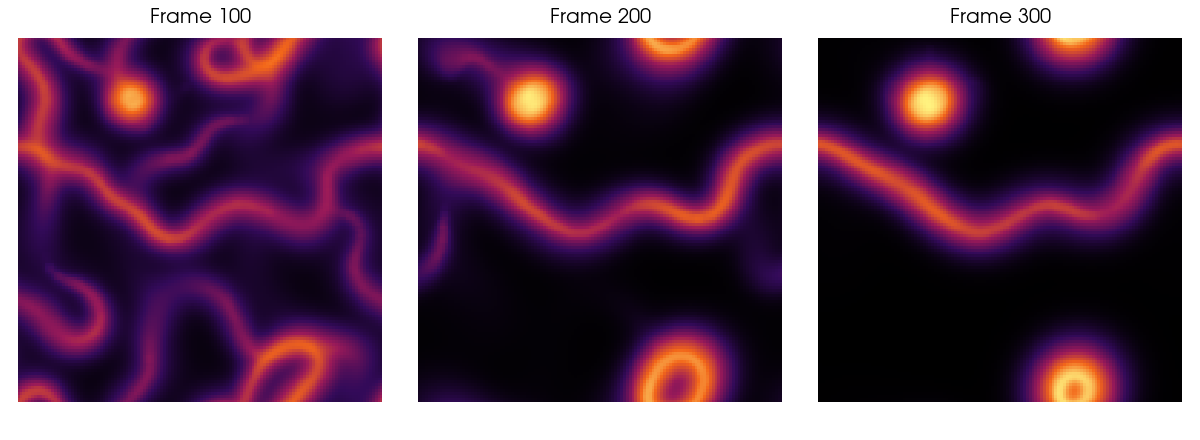
Origin: adapted from Taichi's Physarum example, Copyright © The Taichi Authors, Apache-2.0. Taichi credits Sage Jenson's Physarum work for the model and visual inspiration. This teaching version changes the steering parameters and turn rule, separates the stages, and uses Tack's explicit random state. It is a procedural agent model inspired by trail formation, not a biological solver.
Put related state in a class
Agents owns a position vector and a heading scalar for each agent. Its class
constants describe how far and at what angles agents look. Its instance values
describe this particular simulation:
@tack.device_class
class Agents:
    sense_angle = 0.6
    sense_distance = 4.0
    turn_angle = 0.3

    def __init__(self, n, size):
        self.n = n
        self.size = size
        self.pos = tack.empty((n,), tack.vec2(tack.f32))
        self.heading = tack.empty((n,))

    @tack.func
    def sense(self, trail, p, angle):
        q = int(p + self.sense_distance * [cos(angle), sin(angle)]) % self.size
        return trail[q]

    @tack.kernel
    def initialize(self):
        for i in range(self.n):
            state = random.seed(i, 0)
            x, state = random.uniform(state)
            y, state = random.uniform(state)
            angle, state = random.uniform(state)
            self.pos[i] = [x * self.size, y * self.size]
            self.heading[i] = angle * 6.283185307
The initialization kernel is a method. random.seed(i, 0) gives each agent its
own stream; each draw returns a value and the next state. Reusing the same seed
would repeat the sequence. The sensing helper wraps cell indices modulo the
grid size, making the domain periodic.
Keep sensing separate from depositing
The move kernel reads a completed trail. The deposit kernel then adds one unit
at each agent's new cell. Several agents may land in the same cell, so this is a
scatter and requires atomic_add. Diffusion gathers a 3×3 neighbourhood into
a separate output buffer:
@tack.kernel
def move(agents, trail, frame):
    for i in range(agents.n):
        p, angle = agents.pos[i], agents.heading[i]
        left = agents.sense(trail, p, angle - agents.sense_angle)
        center = agents.sense(trail, p, angle)
        right = agents.sense(trail, p, angle + agents.sense_angle)
        if left > center and left > right:
            angle -= agents.turn_angle
        elif right > center and right > left:
            angle += agents.turn_angle
        elif center < left and center < right:
            coin, state = random.uniform(random.seed(i, frame + 1))
            angle += agents.turn_angle * (2 * int(coin < 0.5) - 1)
        agents.pos[i] = (p + tack.vec2(cos(angle), sin(angle))) % agents.size
        agents.heading[i] = angle


@tack.kernel
def deposit(agents, trail):
    for i in range(agents.n):
        cell = int(agents.pos[i]) % agents.size
        tack.atomic_add(trail, cell, 1.0)


@tack.kernel
def diffuse(old, new, size, evaporation):
    for i, j in tack.ndindex(size, size):
        total = 0.0
        for di in range(-1, 2):
            for dj in range(-1, 2):
                total += old[(i + di) % size, (j + dj) % size]
        new[i, j] = total * evaporation / 9.0
Combining sensing and deposition in one launch would let the sensed trail depend on which agents had already deposited. Keeping the calls separate gives the stages a defined ordering. The vector position update wraps in floating coordinates; the subsequent integer cell index is therefore within the grid.
The host coordinates the stages:
    for frame in range(frames):
        move(agents, old, frame)
        deposit(agents, old)
        diffuse(old, new, size, evaporation)
        old, new = new, old
        expected_mass = (expected_mass + n) * evaporation
        if (frame + 1) % (frames // 3 if not check else frames) == 0:
            snapshots.append(old.numpy())
The two trail buffers come from tack.zeros: the first move senses the trail
before any deposit, and a new array's contents are unspecified. Here
expected_mass is diagnostic host state. It predicts the total trail after
adding one deposit per agent and multiplying by the evaporation factor.
Run and validate
uv run python docs/examples/physarum.py --check
uv run --with vtk python docs/examples/physarum.py --output physarum.png
The check verifies that positions remain in the periodic domain, values remain
finite and nonnegative, and total trail matches the independent recurrence
M_next = (M + number_of_agents) * evaporation. It does not demand bitwise
identical long trajectories: sensing decisions can amplify small differences.
The figure uses log1p(trail) with a common colour scale to reveal both weak
and strong trails. Try changing sensing distance or evaporation while holding
initialization fixed. Increase particle count and watch for atomic contention;
time the stages individually before choosing an optimization.
Complete program
Download physarum.py. The adapted code is Apache-2.0 licensed.
# Copyright (c) 2026 Kitware, Inc.
# SPDX-License-Identifier: Apache-2.0
"""Trail-following agents, adapted from Taichi's Physarum example.

Copyright (c) The Taichi Authors. Apache-2.0; see LICENSE-APACHE-2.0.txt.
Source: https://github.com/taichi-dev/taichi/blob/master/python/taichi/examples/simulation/physarum.py
Model and visual inspiration: Sage Jenson, https://sagejenson.com/physarum
"""

import argparse

import numpy as np

import tack
from tack import random


@tack.device_class
class Agents:
    sense_angle = 0.6
    sense_distance = 4.0
    turn_angle = 0.3

    def __init__(self, n, size):
        self.n = n
        self.size = size
        self.pos = tack.empty((n,), tack.vec2(tack.f32))
        self.heading = tack.empty((n,))

    @tack.func
    def sense(self, trail, p, angle):
        q = int(p + self.sense_distance * [cos(angle), sin(angle)]) % self.size
        return trail[q]

    @tack.kernel
    def initialize(self):
        for i in range(self.n):
            state = random.seed(i, 0)
            x, state = random.uniform(state)
            y, state = random.uniform(state)
            angle, state = random.uniform(state)
            self.pos[i] = [x * self.size, y * self.size]
            self.heading[i] = angle * 6.283185307


@tack.kernel
def move(agents, trail, frame):
    for i in range(agents.n):
        p, angle = agents.pos[i], agents.heading[i]
        left = agents.sense(trail, p, angle - agents.sense_angle)
        center = agents.sense(trail, p, angle)
        right = agents.sense(trail, p, angle + agents.sense_angle)
        if left > center and left > right:
            angle -= agents.turn_angle
        elif right > center and right > left:
            angle += agents.turn_angle
        elif center < left and center < right:
            coin, state = random.uniform(random.seed(i, frame + 1))
            angle += agents.turn_angle * (2 * int(coin < 0.5) - 1)
        agents.pos[i] = (p + tack.vec2(cos(angle), sin(angle))) % agents.size
        agents.heading[i] = angle


@tack.kernel
def deposit(agents, trail):
    for i in range(agents.n):
        cell = int(agents.pos[i]) % agents.size
        tack.atomic_add(trail, cell, 1.0)


@tack.kernel
def diffuse(old, new, size, evaporation):
    for i, j in tack.ndindex(size, size):
        total = 0.0
        for di in range(-1, 2):
            for dj in range(-1, 2):
                total += old[(i + di) % size, (j + dj) % size]
        new[i, j] = total * evaporation / 9.0


def run(arch="cpu", check=False):
    tack.set_default_device(arch)
    n, size, frames = (128, 24, 8) if check else (4096, 128, 300)
    agents = Agents(n, size)
    agents.initialize()
    old = tack.zeros((size, size))
    new = tack.zeros((size, size))
    evaporation = 0.96
    expected_mass = 0.0
    snapshots = []
    for frame in range(frames):
        move(agents, old, frame)
        deposit(agents, old)
        diffuse(old, new, size, evaporation)
        old, new = new, old
        expected_mass = (expected_mass + n) * evaporation
        if (frame + 1) % (frames // 3 if not check else frames) == 0:
            snapshots.append(old.numpy())
    if check:
        trail = old.numpy()
        pos = agents.pos.numpy()
        assert np.all(np.isfinite(trail)) and trail.min() >= 0
        assert np.all((pos >= 0) & (pos < size))
        # Every deposit adds one, and periodic averaging preserves mass.
        np.testing.assert_allclose(trail.sum(dtype=np.float64), expected_mass, rtol=3e-6)
    return snapshots


def save_figure(snapshots, output):
    import vtkmodules.vtkRenderingFreeType  # register text rendering
    import vtkmodules.vtkRenderingOpenGL2  # noqa: F401  # register the rendering backend
    from vtkmodules.vtkCommonCore import VTK_RGB, VTK_TEXT_CENTERED, VTK_TEXT_TOP, vtkFloatArray
    from vtkmodules.vtkCommonDataModel import vtkImageData
    from vtkmodules.vtkImagingCore import vtkImageMapToColors
    from vtkmodules.vtkIOImage import vtkPNGWriter
    from vtkmodules.vtkRenderingCore import (
        VTK_NORMALIZED_VIEWPORT,
        vtkColorTransferFunction,
        vtkImageActor,
        vtkRenderer,
        vtkRenderWindow,
        vtkTextActor,
        vtkWindowToImageFilter,
    )
    scale = max(float(np.log1p(x).max()) for x in snapshots)
    # One shared colour range makes changes across panels comparable.
    colour = vtkColorTransferFunction()
    for fraction, rgb in ((0.0, (0.0, 0.0, 0.0)), (0.25, (0.2, 0.04, 0.35)),
                          (0.5, (0.6, 0.1, 0.35)), (0.75, (0.95, 0.4, 0.1)),
                          (1.0, (1.0, 0.95, 0.5))):
        colour.AddRGBPoint(fraction * scale, *rgb)
    window = vtkRenderWindow(off_screen_rendering=True, multi_samples=0,
                             size=(400 * len(snapshots), 440))
    for index, (snapshot, label) in enumerate(zip(snapshots, ("Frame 100", "Frame 200", "Frame 300"), strict=True)):
        data = np.ascontiguousarray(np.log1p(snapshot.T))
        image = vtkImageData(dimensions=(data.shape[1], data.shape[0], 1))
        # Attribute data has no settable scalars property: SetScalars makes them active.
        image.point_data.SetScalars(vtkFloatArray(data.ravel()))
        actor = vtkImageActor(interpolate=False)
        image >> vtkImageMapToColors(lookup_table=colour, output_format=VTK_RGB) >> actor.mapper
        renderer = vtkRenderer(background=(1, 1, 1),
                               viewport=(index / len(snapshots), 0, (index + 1) / len(snapshots), 1))
        renderer.AddActor(actor)
        title = vtkTextActor(input=label, position=(0.5, 0.98))
        title.position_coordinate.coordinate_system = VTK_NORMALIZED_VIEWPORT
        text = title.text_property
        text.justification = VTK_TEXT_CENTERED
        text.vertical_justification = VTK_TEXT_TOP
        text.font_size = 20
        text.color = (0, 0, 0)
        renderer.AddViewProp(title)
        camera = renderer.active_camera
        cx, cy = (data.shape[1] - 1) / 2, (data.shape[0] - 1) / 2
        camera.position = (cx, cy, 1)
        camera.focal_point = (cx, cy, 0)
        camera.parallel_projection = True
        camera.parallel_scale = data.shape[0] * 0.6
        window.AddRenderer(renderer)
    window.Render()
    capture = vtkWindowToImageFilter(input=window, read_front_buffer=False)
    writer = vtkPNGWriter(file_name=str(output))
    capture >> writer
    writer.Write()  # calling the writer, or updating it, writes raw pixels instead of a PNG
    window.Finalize()


if __name__ == "__main__":
    parser = argparse.ArgumentParser(description=__doc__)
    parser.add_argument("--arch", default="cpu", choices=["cpu", "metal", "cuda", "hip", "level_zero"])
    parser.add_argument("--check", action="store_true")
    parser.add_argument("--output", help="Save a figure (requires VTK; use without --check)")
    args = parser.parse_args()
    images = run(args.arch, args.check)
    if args.output:
        if args.check:
            parser.error("use --output without --check")
        save_figure(images, args.output)
    print("Physarum: check passed" if args.check else "Physarum: simulation complete")