What is QuickView? 

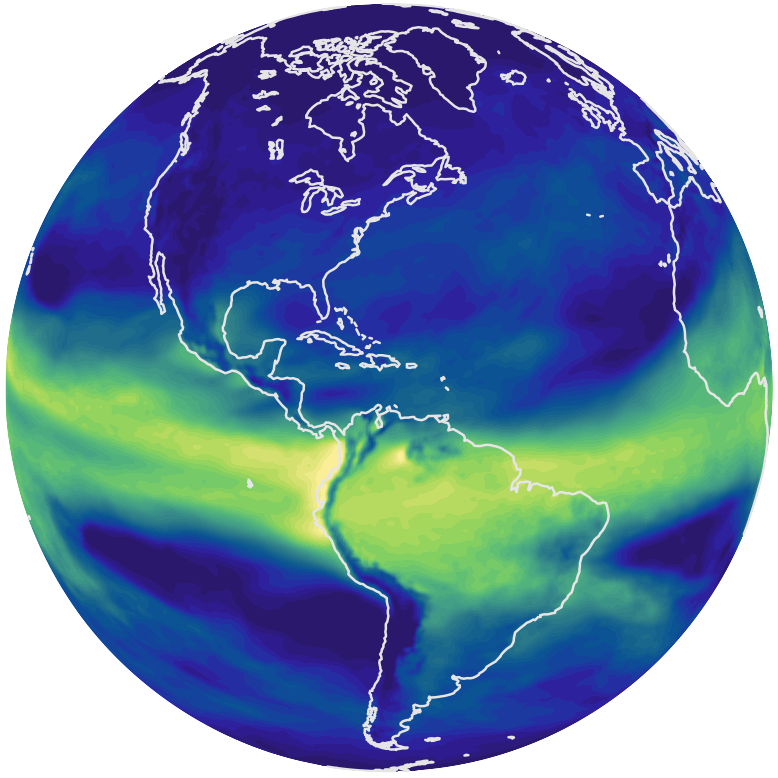
QuickView is an open-source, interactive visualization tool designed to help Earth system modelers take a quick look at a collection of physical quantities in their simulation files. The physical quantities are presented in the form of global or regional maps. Currently, QuickView supports only cubed-sphere grids, i.e., the ne*np4 and ne*pg2 meshes used by the atmosphere component of the Energy Exascale Earth System Model (E3SM), but extensions to other grids are underway. QuickView's Python- and trame-based User Interface (UI) provides intuitive access to ParaView's powerful analysis and visualization capabilities without requiring a steep learning curve.
Useful resources: see linked page.
Why QuickView? 
While comprehensive visualization tools like ParaView and VisIt are widely used in the scientific community, they often have very steep learning curves—requiring users who are not experts in visual analytics to navigate unfamiliar interfaces, functions, and jargon. Moreover, these general-purpose tools may lack out-of-the-box support for key requirements in atmospheric sciences, such as globe and map projections or support for specific data formats and structures, leading to time-consuming customization or feature requests. QuickView was developed to address these limitations by offering a focused, user-friendly platform that streamlines the analysis of atmospheric simulations. It minimizes the need for E3SM developers and users to write custom scripts, thereby shortening the path from data to insight.
The primary goal of QuickView is a first glance at the contents in a simulation data file, i.e., a first inspection of the characteristic values of physical quantities and their variations with respect to geographical location, altitude, and time, as well as a quick inspection across different physical quantities for similarities or distinctions. Compared to earlier and widely used tools like ncview and ncvis, QuickView has an emphasis on multivariate visualization and is currently focused on E3SM.
Key Features 
- Intuitive, minimalist interface tailored for Earth system modeling.
- Multi-variable visualization.
- Persistent sessions—pick up where you left off.
- Support for EAM v1-v4 output formats as well as the E3SM land model ELM's input and output files on cubed-sphere grids.
Project Background 
The lead developer of QuickView version 2 is Sebastien Jourdain at Kitware. Other key contributors include Patrick O'Leary, Berk Geveci, Dan Lipsa, and Will Dunklin at Kitware as well as Hui Wan and Kai Zhang at Pacific Northwest National Laboratory.
QuickView is a product of an interdisciplinary collaboration supported by the U.S. Department of Energy Office of Science’s Advanced Scientific Computing Research (ASCR) and Biological and Environmental Research (BER) via the Scientific Discovery through Advanced Computing (SciDAC) program.
The development of QuickView used resources of the National Energy Research Scientific Computing Center (NERSC), a U.S. Department of Energy User Facility.