Type List
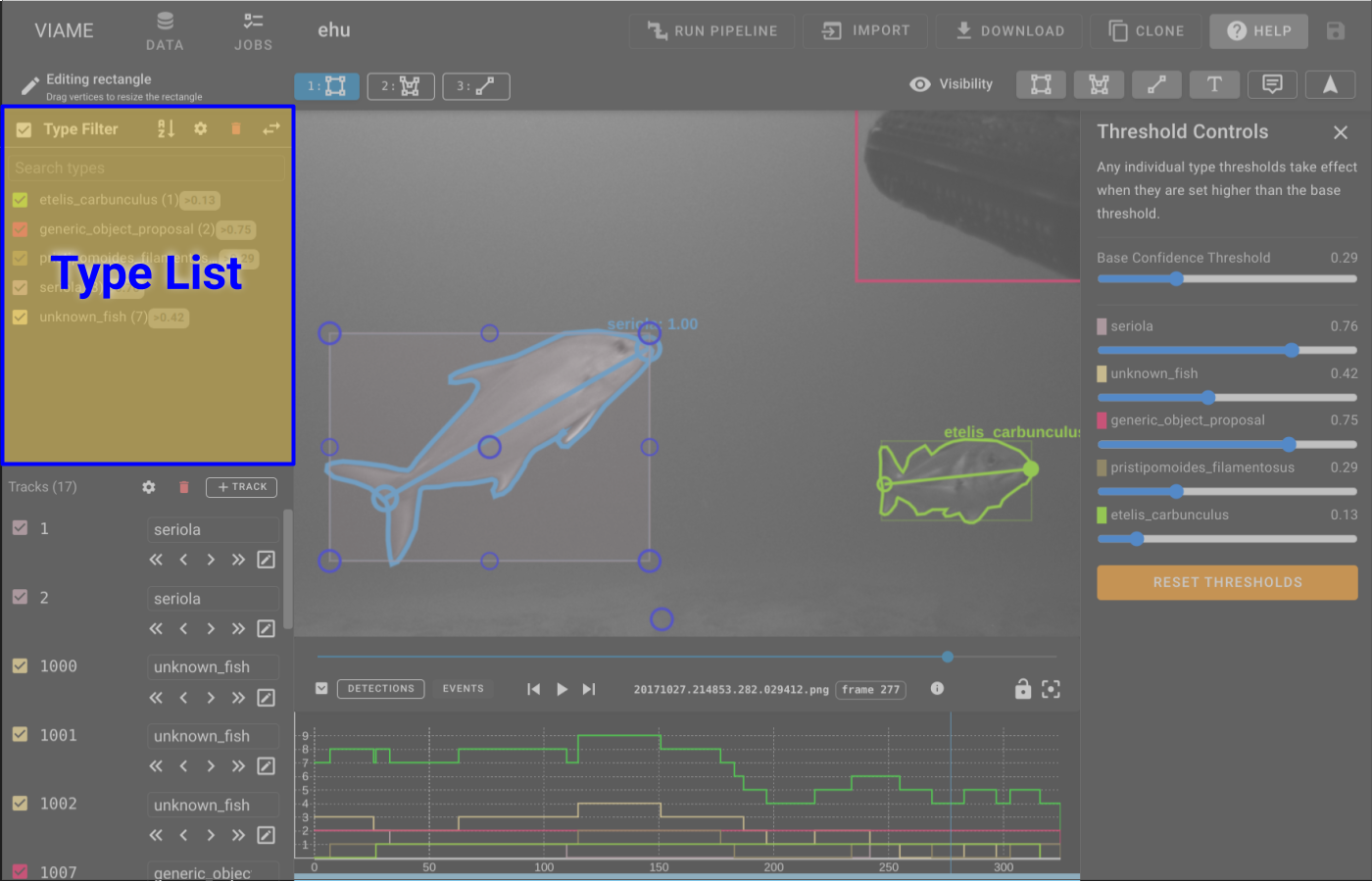
Type List Controls
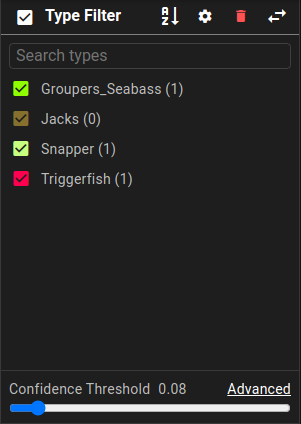
Each dataset maintains its own list of types, and types can be defined on-the-fly.
The Type List is used to control visual styles of the different types as well as filter out types that don't need to be displayed.
- Rows show frame count / total count before the type name, for example
3 / 12 red-snapper. Either count can be hidden in type settings. - The checkbox next to each type name can be used to toggle types on and off.
- The checkbox in the list heading toggles only the types the list is currently showing. A checked type that a filter has hidden keeps its checked state.
- toggles the sort order between alphabetical and by number of annotations of each type.
- opens the type settings menu.
- will remove the type from any visible track or delete the track if it is the only type. Like the heading checkbox, it acts only on the types the list is showing.
- will switch the left sidebar panel to show the track attribute editor (and group editor) view.
Hierarchical Types
When a dataset has a type hierarchy, DIVE displays the deepest checked type whose confidence meets its threshold. For example, given fish → shark → great white shark, if great white shark falls below its threshold while shark passes, the track displays as shark. Confidence values do not need to decrease or increase monotonically through the hierarchy; DIVE selects from the qualifying pairs and preserves confidence-pair order between unrelated branches.
Type-specific track and detection attribute filters match this hierarchy-resolved displayed type, so the type picker and the filter operate on the same classification identity.
Assigning a type to a track is hierarchy-aware. A type together with its ancestors and descendants is one classification claim, so assigning over any pair in that lineage replaces the whole chain rather than leaving a relative behind for the display to select instead. Stored ancestors of the newly assigned type survive because the assignment still implies them, and pairs on unrelated branches are untouched.
Accept as correct is a separate command: it sets the accepted pair to 1.0, keeps stored ancestors and descendants at their existing scores, and removes unrelated pairs. Editing a confidence value to 1.0 does not accept the type or remove any other pair.
Track notes, track attributes, and first-detection attributes edited from a track row are logical-track values. They are written to every linked camera track, using each camera track's own first feature for feature-level values. Keyframe and interpolation controls edit geometry only in the selected camera.
Linked multicamera tracks are expected to store identical confidence-pair vectors. If existing camera replicas differ, DIVE reports one warning when the dataset loads and uses the first camera in configured display order for the read-only track projection; it does not union classifications while merging display geometry. Removing classifications evaluates the complete logical vector and synchronizes the result across replicas.
The Web Library's dataset-label aggregation is intentionally different: it reports the raw highest-confidence pair, keeping the first stored pair when scores tie, because the server does not have each viewer's checked types and confidence thresholds. Viewer counts and filtering use the hierarchy-resolved displayed type.
Hierarchy members render as an expandable tree rather than ordinary flat rows. Parent checkboxes control their complete subtrees, and parent counts include descendants.
A parent row's checkbox always toggles its complete subtree. The heading checkbox is narrower: it skips a parent shown only as ancestor context for a match below it.
Compact Parents folds unused shared parent rows into a breadcrumb. Used or configured parents remain as rows. Expand Parents restores the full chain, and searching shows a match's complete path.
While a hierarchy is active, Prevent Cascade Types is disabled and shows: Not applicable to hierarchical types; DIVE selects the deepest qualifying type.
Manage Types
Open the Type List settings cog and choose Manage Types to see every type, including empty types and parents hidden by the list's filters. Use the arrow beside a parent to collapse or expand its branch, or use Expand All / Collapse All. Search temporarily expands matching branches and restores the collapsed state when cleared. Branch counts remain visible when collapsed.
- Use the pencil to rename a type, change its parent, or adjust its appearance. Clearing Parent Type moves the type to the top level. Children follow their parent when it moves.
- Direct tracks counts tracks that explicitly carry that label. Branch tracks includes descendants, counting each track only once. These counts include all cameras and ignore visibility, confidence, frame, and attribute filters.
- Use the trash button to delete a type. Its children move to its parent, or to the top level if it has no parent. For types with a parent, optionally check Delete empty parents too to remove ancestors left without child types or directly assigned tracks. For types with children, optionally check Delete empty children too to remove descendant types left without child types or directly assigned tracks. Cleanup stops at the first type still in use; both options start unchecked.
- If tracks directly carry the deleted type, choose either to transfer that label to
unknown(keeping other labels and annotations) or to delete those entire tracks from every camera. Tracks carrying only descendant labels are kept. Cancel leaves the type and tracks unchanged.
Changes apply immediately and are persisted when you save the dataset. Read-only mode allows inspecting counts but disables editing and deletion.
Type Style Editor
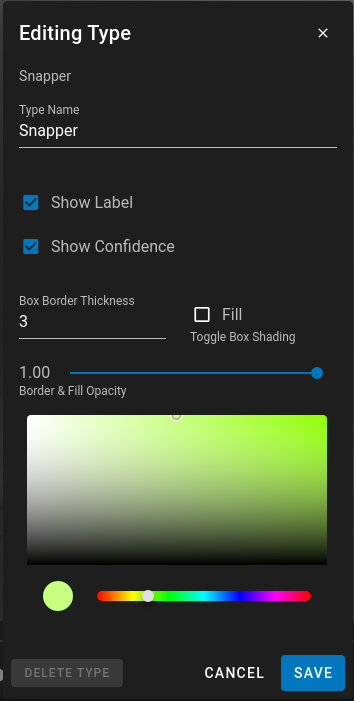
The type style editor controls the visual appearance of annotations in all other areas of the application. Launch the editor by hovering over a type row in the list and clicking (the edit pencil).
- Type Name - You can change the name for the type and it will update all subsequent tracks that are using that Type.
- Parent Type - Select a parent for the type, or clear it to make the type top-level.
- Show Label - show the type name label in the text above each box.
- Show Confidence - show the confidence value in the text above each box.
- Box Border Thickness - the line thickness can be changed to make a type stand out more or less
- Fill - Fill allows the bounding box to be filled. This is useful for annotation of background items in an image.
- Border & Fill Opacity - The opacity of the lines and the fill can be set here.
- Color - The color for the type within the annotations and the timeline views.
Where those colors are reused across datasets depends on Type color scope (see below).
Type color scope and Saved Styles
Open User Settings with in the navigation bar.
Type color scope
- Shared across all data (default) — one set of type and group color/style overrides is reused across every dataset.
- On Desktop, styles are stored once per data directory in
global_style_settings.json(see Data Storage Path). - On Web, styles are stored in the current browser for the signed-in session (
localStorage), not synced across devices. - When you open a dataset, shared styles overlay that dataset's own styling (shared wins on conflicts). Edits you make are mirrored back to the shared store. Colors that arrive with a dataset seed the shared store without overwriting styles you already chose.
- Per dataset — colors and styles are saved only with the dataset they were set on (the original behavior).
Changing the scope takes effect the next time a dataset is opened.
Saved Styles
The Saved Styles panel in User Settings lists the shared type and group styles. You can filter by name or source dataset, add or edit styles, and delete one or many entries. Use this to curate the palette that Shared scope applies across sequences. Group styles follow the same rules; see Group Manager.
Type Settings Menu
Click the button in the type list heading to open type settings.
Ad-hoc mode
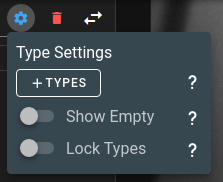
In ad-hoc mode, new object classes are added as you annotate. The type list updates automatically when new classes are added or the last member of a class is deleted.
- Set Lock Types to off for ad-hoc type creation.
- Set Show Empty to still show manually defined types with no track/detection examples in the type list. Hierarchy parents appear only when something in their branch is annotated.
- Use Show Total Count and Show Frame Count to choose which counts appear in each row.
Locked mode
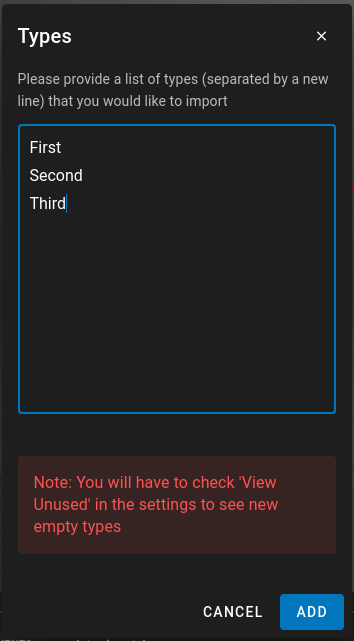
In locked mode, only a specified list of classes can be used, and must be selected or autocompleted from the list for each object.
- Set Lock Types to on to constrain annotation types to those already defined.
- You can add new types using the Types button under type settings.
Pre-loading a species list
Typing a long list into Types for every video does not scale. To pre-load the
same classes everywhere, import a KWCOCO Species List — a
KWCOCO categories block with no images or annotations. Every name becomes a declared type and
every supercategory becomes a hierarchy edge, so a taxonomy arrives as a
tree rather than a flat list.
Import it from Import in the viewer, from the Species List field at upload, or by naming
it to end in species.json and placing it beside the media. Overwrite replaces the declared
list; an additive import adds to it. Turning Lock Types on is a separate choice: the file
supplies the list, the setting decides whether readers may go outside it.
Suppression
Type settings also configure suppression:
- Suppression Region Type — annotations of this type act as ignore / occlusion regions. Detections covered by at least the overlap threshold are hidden and excluded from counts. Clear the field to disable suppression. Defaults to
Suppressed. - Suppression Overlap (%) — minimum percent of a detection that must lie under suppression regions for it to be hidden (default 99). Shown only when a suppression type is set.
The active suppression type shows an icon in the type list. Detections may also be flagged with an attribute of the same name; see Suppression for region vs attribute behavior and display options.
Remembered hierarchy view
The type list remembers Expand Parents / Compact Parents and each collapsed branch per sequence. Returning from Review or another page, changing between sidebar and bottom layouts, and reopening the application restores that view before the list renders. Reloading hierarchy metadata does not reset expansion. Other sequences keep their own view; category definitions, checked types, and confidence thresholds are unchanged. Preferences are saved locally for the most recent 100 sequences, with an in-memory fallback if browser storage is unavailable.
Importing types from files
Use Type Settings → Types to import COCO JSON or VIAME .txt, .csv, and
.json category files, including parent relationships. The WoRMS tab searches
marine scientific names and imports selected taxa with optional taxonomic parents. See
Importing object types for formats and examples.